Digital identity technologies applied to secure authentication in decentralized ecosystems
DOI:
https://doi.org/10.64439/cisai.v2i2.47Keywords:
blockchain, self-sovereign identity, decentralized identifiers, secure authentication, verifiable credentialsAbstract
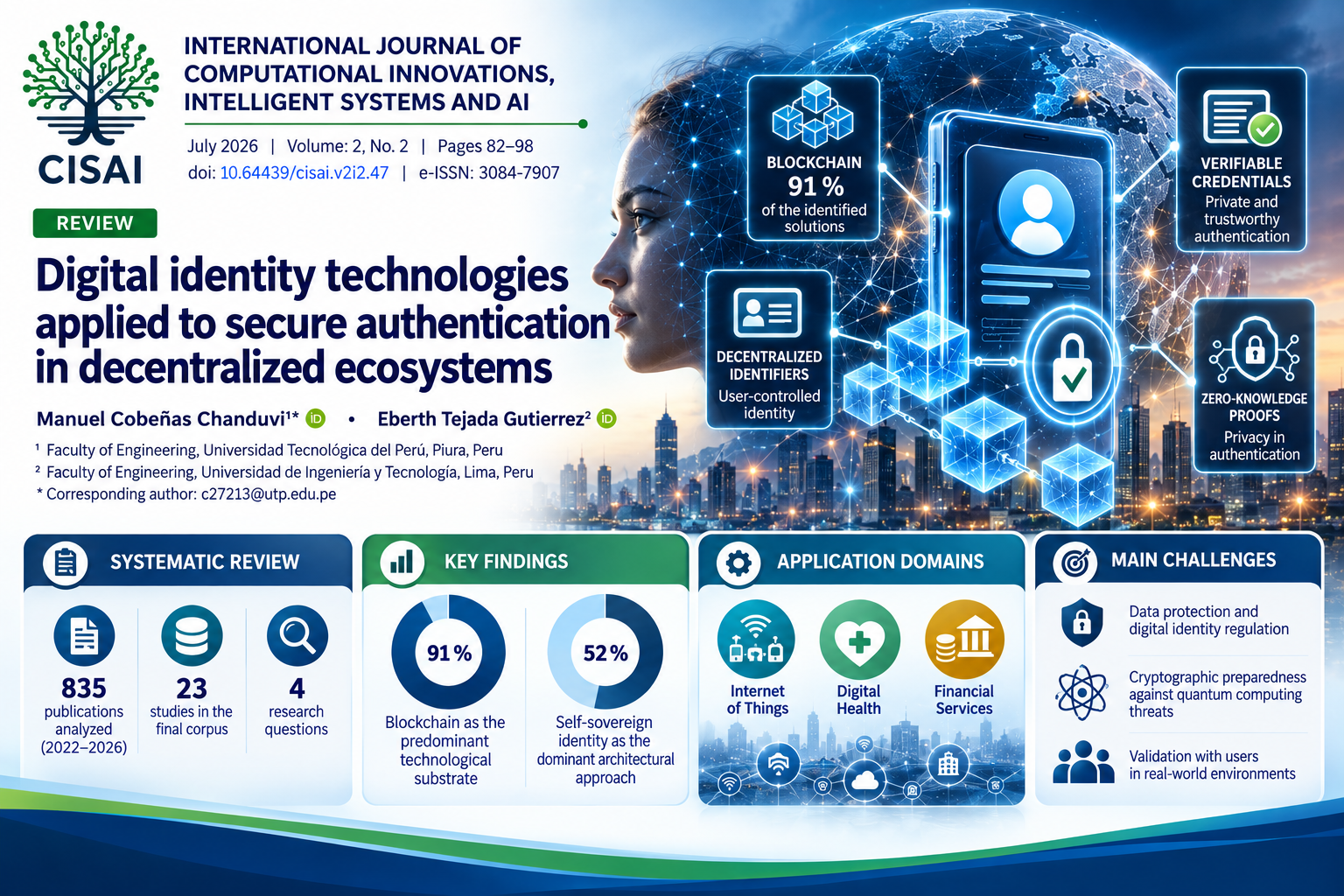
Ensuring secure user authentication in decentralized ecosystems constitutes one of the most complex challenges of digital identity, given that current technologies do not offer sufficient guarantees of privacy or individual sovereignty. With the aim of addressing this gap, this work carries out a systematic literature review guided by four research questions framed around digital identity technologies, methodological approaches, application domains, and regulatory frameworks. A total of 835 scientific publications from the 2022-2026 period were analyzed, of which 23 formed the final corpus. The analysis reveals that blockchain technology constitutes the predominant technological substrate in 91% of the identified solutions, while the self-sovereign identity paradigm represents the dominant architectural approach in 52% of the studies. In particular, decentralized identifiers, verifiable credentials, and zero-knowledge proofs are consolidated as the canonical architecture for private authentication. Likewise, the domains linked to the internet of things, digital health, and financial services show the highest density of documented implementations. However, the challenges left by this analysis are concentrated in data protection and digital identity regulation, in cryptographic preparedness against quantum computing threats, and in validation with users in real-world environments.
References
[1] C. Mazzocca, A. Acar, S. Uluagac, R. Montanari, P. Bellavista, and M. Conti, “A survey on decentralized identifiers and verifiable credentials,” IEEE Communications Surveys and Tutorials, 2025. doi: 10.1109/COMST.2025.3543197.
[2] U. Arshad, A. Tubaishat, S. Anwar, Z. Halim, A. Abualkishik, and A. Ullah, “Web3-based identity and kyc innovations for next-generation fintech,” ACM Transactions on the Web, 2026. doi: 10.1145/3771991.
[3] M. R. Ahmed, A. K. M. M. Islam, S. Shatabda, and S. Islam, “Blockchain-based identity management system and self-sovereign identity ecosystem: A comprehensive survey,” IEEE Access, vol. 10, pp. 113436–113481, 2022. doi: 10.1109/ACCESS.2022.3216643.
[4] H. Deng, J. Liang, C. Zhang, X. Liu, L. Zhu, and S. Guo, “FutureDID: A fully decentralized identity system with multi-party verification,” IEEE Transactions on Computers, 2024. doi: 10.1109/TC.2024.3365271.
[5] Z. Z. Li, H. Cui, A. C. Y. Leung, D. Y. W. Liu, J. K. Liu, J. Yu, and D. Gasevic, “DisIMS: A distributed identity management system via blockchain,” IEEE Transactions on Dependable and Secure Computing, 2026. doi: 10.1109/TDSC.2025.3624710.
[6] J. Lindquist, “Introducing privacy receipts into DLT and eIDAS,” Journal of ICT Standardization, vol. 11, no. 3, pp. 177–202, 2023. doi: 10.13052/jicts2245-800X.1132.
[7] E. Bureaca, R.-A. Leanca, I. Ciobanu, A. Brinzea, and I. Aciobaniţei, “Unlinkable revocation lists for qualified electronic attestations: A blockchain-based framework,” Electronics, vol. 14, no. 14, p. 2795, 2025. doi: 10.3390/electronics14142795.
[8] E. Samir, H. Wu, M. Azab, C. Xin, and Q. Zhang, “DT-SSIM: A decentralized trustworthy self-sovereign identity management framework,” IEEE Internet of Things Journal, vol. 9, no. 11, pp. 8688–8701, 2022. doi: 10.1109/JIOT.2021.3112537.
[9] E. S. Fathalla, M. Azab, C. Xin, and H. Wu, “PT-SSIM: A proactive, trustworthy self-sovereign identity management system,” IEEE Internet of Things Journal, vol. 10, no. 6, pp. 5401–5415, 2023. doi: 10.1109/JIOT.2022.3222610.
[10] D. Pöhn, M. Grabatin, and W. Hommel, “Modeling the threats to self-sovereign identities,” in Proceedings of the Open Identity Summit 2023, 2023. doi: 10.18420/OID2023_07.
[11] T. Rathee and P. Singh, “A systematic literature mapping on secure identity management using blockchain technology,” Journal of King Saud University – Computer and Information Sciences, vol. 34, no. 8, pp. 5782–5796, 2022. doi: 10.1016/j.jksuci.2021.03.005.
[12] R. Tertulino, F. Vidal, and N. Ivaki, “A decentralized architecture for electronic health records to enhanced security and privacy,” in Proceedings – 2025 20th European Dependable Computing Conference Companion Proceedings, EDCC-C 2025, 2025, pp. 174–179. doi: 10.1109/EDCC-C66476.2025.00052.
[13] J. Fry and G. Hileman, “Challenges of user data privacy in self-sovereign identity verifiable credentials for autonomous building access,” Frontiers in Blockchain, vol. 7, p. 1374655, 2024. doi: 10.3389/fbloc.2024.1374655.
[14] R. Xiong, W. Ren, X. Hao, J. He, and K.-K. R. Choo, “BDIM: A blockchain-based decentralized identity management scheme for large scale internet of things,” IEEE Internet of Things Journal, 2023. doi: 10.1109/JIOT.2022.3228219.
[15] T. Bai, Y. Hu, J. He, H. Fan, and Z. An, “Health-zkidm: A healthcare identity system based on fabric blockchain and zero-knowledge proof,” Sensors, vol. 22, no. 22, p. 8586, 2022. doi: 10.3390/s22228586.
[16] I. Ahmed, K. Toyoda, T. Nakano, S. Kasahara, S. R. Goyal, and T. H. Tran, “A systematic review on blockchain-enabled eKYC: Leveraging SSI and DID for secure and efficient identity verification,” IEEE Internet of Things Journal, 2025. doi: 10.1109/JIOT.2025.3597356.
[17] Q. An, F. Jiang, C. Dong, S. Pal, J. Li, A. G. Neiat, and W. Yeoh, “A blockchain-powered secure architecture for cyber marketplaces of electric vehicles,” IEEE Transactions on Industry Applications, vol. 61, no. 3, pp. 4198–4213, 2025. doi: 10.1109/TIA.2025.3536421.
[18] Y.-H. Hsieh, C.-H. Tseng, B.-Y. Luo, and S.-M. Yuan, “Cross-border digital identity system based on ethereum layer 2 architecture,” Electronics, vol. 15, no. 3, p. 708, 2026. doi: 10.3390/electronics15030708.
[19] S. M. Smith and C. Dion-Schwarz, “Mechanisms for digital transformation in the education and healthcare sectors utilizing decentralized self-sovereign identity,” International Journal of Network Security and Applications, vol. 15, no. 2, 2023. doi: 10.5121/ijnsa.2023.15201.
[20] G. Zhang, Q. Hu, Y. Zhang, and T. Jiang, “A blockchain-based user-centric identity management toward 6G networks,” Digital Communications and Networks, 2026. doi: 10.1016/j.dcan.2025.05.009.
[21] R. A. Pava-Diaz, J. Gil-Ruiz, and D. A. Lopez-Sarmiento, “Self-sovereign identity on the blockchain: Contextual analysis and quantification of ssi principles implementation,” Frontiers in Blockchain, vol. 7, p. 1443362, 2024. doi: 10.3389/fbloc.2024.1443362.
[22] S. Cucko, S. Becirovic, A. Kamisalic, S. Mrdovic, and M. Turkanovic, “Towards the classification of self-sovereign identity properties,” IEEE Access, vol. 10, pp. 60908–60928, 2022. doi: 10.1109/ACCESS.2022.3166866.
[23] Z. B. Sassi, C. C. Yaici, J. Xiang, O. Salem, and A. Mehaoua, “Benchmarking zero-knowledge proof-based authentication protocols,” in Proceedings of IEEE SOFTT 2025, 2025. doi: 10.1109/SOFTT67007.2025.11212915.
[24] J. H. M. Emati, V. K. Tchendji, and M. Djam-Doudou, “A zero-trust decentralized identifier specification based machine learning against cyber-attacks in blockchain based self-sovereign identity,” Journal of Cloud Computing, 2026. doi: 10.1186/s13677-026-00862-0.
[25] N. Naik, P. Grace, P. Jenkins, K. Naik, and J. Song, “An evaluation of potential attack surfaces based on attack tree modelling and risk matrix applied to self-sovereign identity,” Computers & Security, vol. 114, p. 102808, 2022. doi: 10.1016/j.cose.2022.102808.
[26] Y. Lee, H. Shin, and D. Choi, “A survey on credential revocation and DID deactivation in self-sovereign identity systems,” IEEE Access, 2026. doi: 10.1109/ACCESS.2025.3649792.
[27] V. Kersic, U. Vidovic, A. Vrecko, M. Domajnko, and M. Turkanovic, “Orchestrating digital wallets for on- and off-chain decentralized identity management,” IEEE Access, vol. 11, pp. 13126–13147, 2023. doi: 10.1109/ACCESS.2023.3242817.
[28] H.-Y. Paik, Y. Liu, Q. Lu, and S. S. Kanhere, “Decentralized identity management and blockchains: Design patterns and architectures,” Advances in Information Security, vol. 100, 2024. doi: 10.1007/978-3-031-32146-7_15.
[29] M. Guerar, M. Migliardi, E. Russo, D. Khadraoui, and A. Merlo, “SSI-MedRx: A fraud-resilient healthcare system based on blockchain and SSI,” Blockchain: Research and Applications, vol. 6, no. 1, 2025. doi: 10.1016/j.bcra.2024.100242.
[30] C. Chen, G. Yang, D. Zhang, W. Wang, Q. Chen, and J. Li, “S3Cross: Blockchain-based cross-domain authentication with self-sovereign and supervised identity management,” IEEE Transactions on Network and Service Management, 2026. doi: 10.1109/TNSM.2025.3642315.
Downloads
Published
How to Cite
Issue
Section
License
Copyright (c) 2026 International Journal of Computational Innovations, Intelligent Systems and AI

This work is licensed under a Creative Commons Attribution-NonCommercial-NoDerivatives 4.0 International License.