Tecnologías de identidad digital aplicadas a la autenticación segura en ecosistemas descentralizados
DOI:
https://doi.org/10.64439/cisai.v2i2.47Palabras clave:
cadena de bloques, identidad autosoberana, identificadores descentralizados, autenticación segura, credenciales verificablesResumen
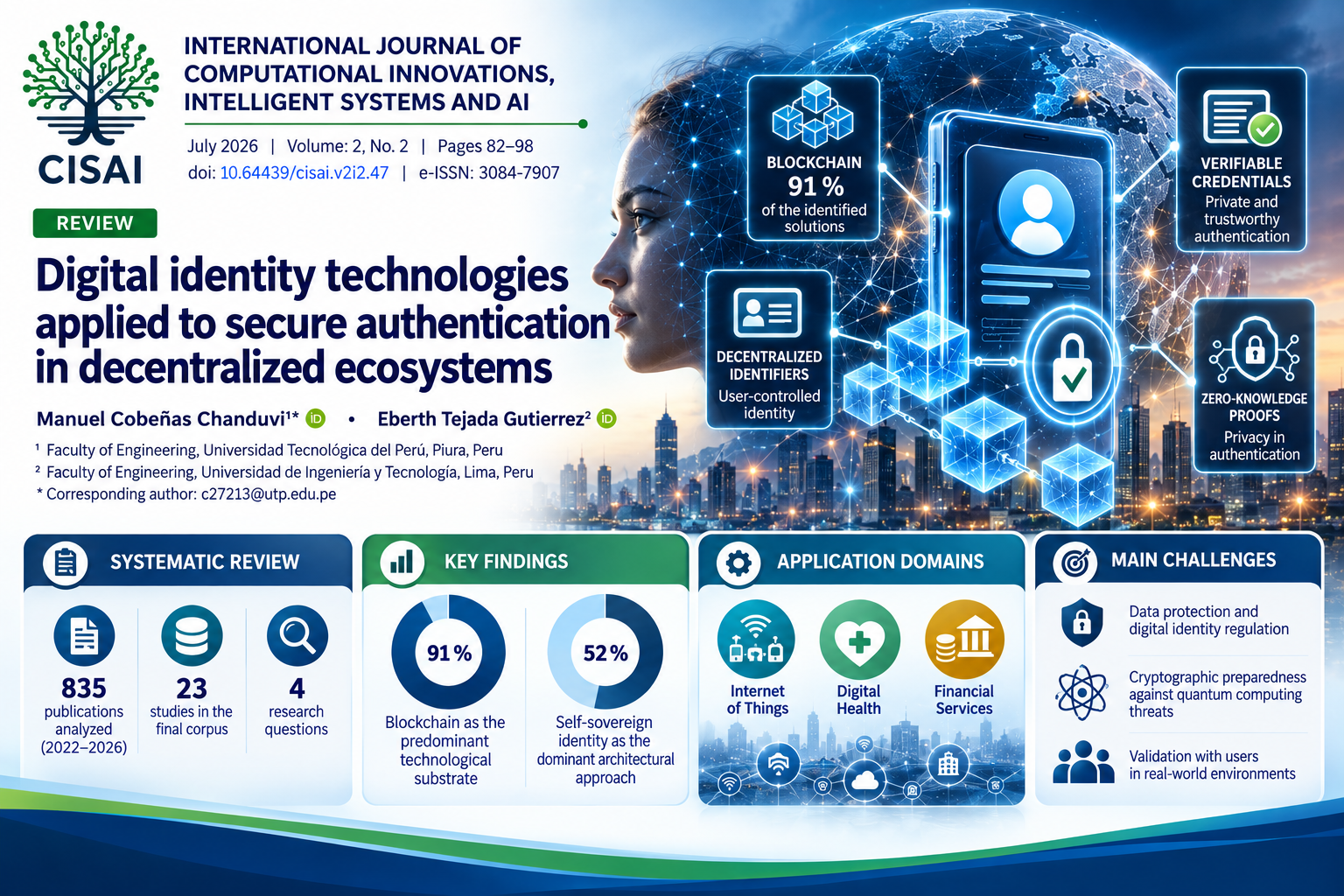
Garantizar la autenticación segura de usuarios en ecosistemas descentralizados constituye uno de los retos más complejos de la identidad digital, dado que las tecnologías actuales no ofrecen garantías suficientes de privacidad ni soberanía individual. Con el objetivo de atender este vacío, este trabajo realiza una revisión sistemática de la literatura guiada por cuatro preguntas de investigación enmarcadas en las tecnologías de identidad digital, enfoques metodológicos, dominios de aplicación y marcos normativos. Se analizaron 835 publicaciones científicas del período 2022-2026, de las cuales 23 conformaron el corpus definitivo. El análisis revela que la tecnología de cadena de bloques constituye el sustrato tecnológico predominante en el 91 % de las soluciones identificadas, mientras que el paradigma de identidad autosoberana representa el enfoque arquitectónico dominante en el 52 % de los estudios. En particular, los identificadores descentralizados, las credenciales verificables y las pruebas de conocimiento cero se consolidan como arquitectura canónica para la autenticación privada. Asimismo, los dominios vinculados al internet de las cosas, la salud digital y los servicios financieros evidencian la mayor densidad de implementaciones documentadas. Sin embargo, los retos que deja este análisis se concentran en la protección de datos y el reglamento de identidad digital, en la preparación criptográfica frente a amenazas de computación cuántica, y en la validación con usuarios en entornos reales.
Citas
[1] C. Mazzocca, A. Acar, S. Uluagac, R. Montanari, P. Bellavista, and M. Conti, “A survey on decentralized identifiers and verifiable credentials,” IEEE Communications Surveys and Tutorials, 2025. doi: 10.1109/COMST.2025.3543197.
[2] U. Arshad, A. Tubaishat, S. Anwar, Z. Halim, A. Abualkishik, and A. Ullah, “Web3-based identity and kyc innovations for next-generation fintech,” ACM Transactions on the Web, 2026. doi: 10.1145/3771991.
[3] M. R. Ahmed, A. K. M. M. Islam, S. Shatabda, and S. Islam, “Blockchain-based identity management system and self-sovereign identity ecosystem: A comprehensive survey,” IEEE Access, vol. 10, pp. 113436–113481, 2022. doi: 10.1109/ACCESS.2022.3216643.
[4] H. Deng, J. Liang, C. Zhang, X. Liu, L. Zhu, and S. Guo, “FutureDID: A fully decentralized identity system with multi-party verification,” IEEE Transactions on Computers, 2024. doi: 10.1109/TC.2024.3365271.
[5] Z. Z. Li, H. Cui, A. C. Y. Leung, D. Y. W. Liu, J. K. Liu, J. Yu, and D. Gasevic, “DisIMS: A distributed identity management system via blockchain,” IEEE Transactions on Dependable and Secure Computing, 2026. doi: 10.1109/TDSC.2025.3624710.
[6] J. Lindquist, “Introducing privacy receipts into DLT and eIDAS,” Journal of ICT Standardization, vol. 11, no. 3, pp. 177–202, 2023. doi: 10.13052/jicts2245-800X.1132.
[7] E. Bureaca, R.-A. Leanca, I. Ciobanu, A. Brinzea, and I. Aciobaniţei, “Unlinkable revocation lists for qualified electronic attestations: A blockchain-based framework,” Electronics, vol. 14, no. 14, p. 2795, 2025. doi: 10.3390/electronics14142795.
[8] E. Samir, H. Wu, M. Azab, C. Xin, and Q. Zhang, “DT-SSIM: A decentralized trustworthy self-sovereign identity management framework,” IEEE Internet of Things Journal, vol. 9, no. 11, pp. 8688–8701, 2022. doi: 10.1109/JIOT.2021.3112537.
[9] E. S. Fathalla, M. Azab, C. Xin, and H. Wu, “PT-SSIM: A proactive, trustworthy self-sovereign identity management system,” IEEE Internet of Things Journal, vol. 10, no. 6, pp. 5401–5415, 2023. doi: 10.1109/JIOT.2022.3222610.
[10] D. Pöhn, M. Grabatin, and W. Hommel, “Modeling the threats to self-sovereign identities,” in Proceedings of the Open Identity Summit 2023, 2023. doi: 10.18420/OID2023_07.
[11] T. Rathee and P. Singh, “A systematic literature mapping on secure identity management using blockchain technology,” Journal of King Saud University – Computer and Information Sciences, vol. 34, no. 8, pp. 5782–5796, 2022. doi: 10.1016/j.jksuci.2021.03.005.
[12] R. Tertulino, F. Vidal, and N. Ivaki, “A decentralized architecture for electronic health records to enhanced security and privacy,” in Proceedings – 2025 20th European Dependable Computing Conference Companion Proceedings, EDCC-C 2025, 2025, pp. 174–179. doi: 10.1109/EDCC-C66476.2025.00052.
[13] J. Fry and G. Hileman, “Challenges of user data privacy in self-sovereign identity verifiable credentials for autonomous building access,” Frontiers in Blockchain, vol. 7, p. 1374655, 2024. doi: 10.3389/fbloc.2024.1374655.
[14] R. Xiong, W. Ren, X. Hao, J. He, and K.-K. R. Choo, “BDIM: A blockchain-based decentralized identity management scheme for large scale internet of things,” IEEE Internet of Things Journal, 2023. doi: 10.1109/JIOT.2022.3228219.
[15] T. Bai, Y. Hu, J. He, H. Fan, and Z. An, “Health-zkidm: A healthcare identity system based on fabric blockchain and zero-knowledge proof,” Sensors, vol. 22, no. 22, p. 8586, 2022. doi: 10.3390/s22228586.
[16] I. Ahmed, K. Toyoda, T. Nakano, S. Kasahara, S. R. Goyal, and T. H. Tran, “A systematic review on blockchain-enabled eKYC: Leveraging SSI and DID for secure and efficient identity verification,” IEEE Internet of Things Journal, 2025. doi: 10.1109/JIOT.2025.3597356.
[17] Q. An, F. Jiang, C. Dong, S. Pal, J. Li, A. G. Neiat, and W. Yeoh, “A blockchain-powered secure architecture for cyber marketplaces of electric vehicles,” IEEE Transactions on Industry Applications, vol. 61, no. 3, pp. 4198–4213, 2025. doi: 10.1109/TIA.2025.3536421.
[18] Y.-H. Hsieh, C.-H. Tseng, B.-Y. Luo, and S.-M. Yuan, “Cross-border digital identity system based on ethereum layer 2 architecture,” Electronics, vol. 15, no. 3, p. 708, 2026. doi: 10.3390/electronics15030708.
[19] S. M. Smith and C. Dion-Schwarz, “Mechanisms for digital transformation in the education and healthcare sectors utilizing decentralized self-sovereign identity,” International Journal of Network Security and Applications, vol. 15, no. 2, 2023. doi: 10.5121/ijnsa.2023.15201.
[20] G. Zhang, Q. Hu, Y. Zhang, and T. Jiang, “A blockchain-based user-centric identity management toward 6G networks,” Digital Communications and Networks, 2026. doi: 10.1016/j.dcan.2025.05.009.
[21] R. A. Pava-Diaz, J. Gil-Ruiz, and D. A. Lopez-Sarmiento, “Self-sovereign identity on the blockchain: Contextual analysis and quantification of ssi principles implementation,” Frontiers in Blockchain, vol. 7, p. 1443362, 2024. doi: 10.3389/fbloc.2024.1443362.
[22] S. Cucko, S. Becirovic, A. Kamisalic, S. Mrdovic, and M. Turkanovic, “Towards the classification of self-sovereign identity properties,” IEEE Access, vol. 10, pp. 60908–60928, 2022. doi: 10.1109/ACCESS.2022.3166866.
[23] Z. B. Sassi, C. C. Yaici, J. Xiang, O. Salem, and A. Mehaoua, “Benchmarking zero-knowledge proof-based authentication protocols,” in Proceedings of IEEE SOFTT 2025, 2025. doi: 10.1109/SOFTT67007.2025.11212915.
[24] J. H. M. Emati, V. K. Tchendji, and M. Djam-Doudou, “A zero-trust decentralized identifier specification based machine learning against cyber-attacks in blockchain based self-sovereign identity,” Journal of Cloud Computing, 2026. doi: 10.1186/s13677-026-00862-0.
[25] N. Naik, P. Grace, P. Jenkins, K. Naik, and J. Song, “An evaluation of potential attack surfaces based on attack tree modelling and risk matrix applied to self-sovereign identity,” Computers & Security, vol. 114, p. 102808, 2022. doi: 10.1016/j.cose.2022.102808.
[26] Y. Lee, H. Shin, and D. Choi, “A survey on credential revocation and DID deactivation in self-sovereign identity systems,” IEEE Access, 2026. doi: 10.1109/ACCESS.2025.3649792.
[27] V. Kersic, U. Vidovic, A. Vrecko, M. Domajnko, and M. Turkanovic, “Orchestrating digital wallets for on- and off-chain decentralized identity management,” IEEE Access, vol. 11, pp. 13126–13147, 2023. doi: 10.1109/ACCESS.2023.3242817.
[28] H.-Y. Paik, Y. Liu, Q. Lu, and S. S. Kanhere, “Decentralized identity management and blockchains: Design patterns and architectures,” Advances in Information Security, vol. 100, 2024. doi: 10.1007/978-3-031-32146-7_15.
[29] M. Guerar, M. Migliardi, E. Russo, D. Khadraoui, and A. Merlo, “SSI-MedRx: A fraud-resilient healthcare system based on blockchain and SSI,” Blockchain: Research and Applications, vol. 6, no. 1, 2025. doi: 10.1016/j.bcra.2024.100242.
[30] C. Chen, G. Yang, D. Zhang, W. Wang, Q. Chen, and J. Li, “S3Cross: Blockchain-based cross-domain authentication with self-sovereign and supervised identity management,” IEEE Transactions on Network and Service Management, 2026. doi: 10.1109/TNSM.2025.3642315.
Descargas
Publicado
Cómo citar
Número
Sección
Licencia
Derechos de autor 2026 International Journal of Computational Innovations, Intelligent Systems and AI

Esta obra está bajo una licencia internacional Creative Commons Atribución-NoComercial-SinDerivadas 4.0.