mHealth as a technological approach for continuous monitoring and psychosocial support in prenatal care
DOI:
https://doi.org/10.64439/cisai.v2i1.18Keywords:
Telemedicine, Perinatal health, Pregnancy, Emotional well-being, Digital interventionAbstract
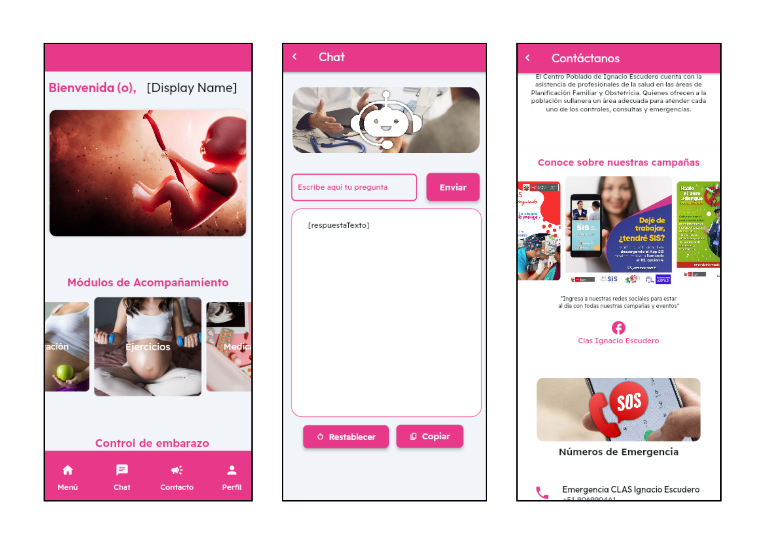
In contexts where psychosocial support during pregnancy is limited in terms of continuity and scope, mHealth solutions are establishing themselves as viable alternatives to complement prenatal care. This applied study with a quantitative approach aimed to develop and evaluate a mobile application designed to monitor and provide psychosocial support to pregnant women. The evaluation was conducted using a pre-experimental design with pre-test and post-test measurements, considering a sample of 20 participants, who were given a questionnaire to measure their level of satisfaction, the relevance of the information, and their ability to understand it. The pre-test results showed limited acceptance of psychosocial support prior to the intervention, with satisfaction levels close to 35%, along with high percentages of neutral responses. After the solution was implemented, favorable responses were identified between 60% and 80% in satisfaction, up to 65% in the perceived relevance of the information, and positive assessments in the ability to understand. These findings confirm the functional viability of the proposal and its effectiveness as digital support to strengthen psychosocial support during pregnancy.
References
[1] N. Barrio-Forné and Á. Gasch-Gallén, “El acompañamiento como método para reducir la ansiedad en embarazadas ingresadas en el tercer trimestre,” Rev. esc. enferm. USP, vol. 55, p. e03749, 2021. https://doi.org/10.1590/s1980-220x2020018603749
[2] B. Caira-Chuquineyra et al., “Prevalence and factors associated with adolescent pregnancy among sexually active adolescent girls in Peru: Evidence from Demographic and Family Health Survey, 2015-2019,” F1000Res, vol. 11, p. 566, Oct. 2023. https://doi.org/10.12688/f1000research.108837.2
[3] J. R. Mejia et al., “Determinants of adolescent pregnancy in indigenous communities from the Peruvian central jungle: a case–control study,” Reprod Health, vol. 18, no. 1, p. 203, Dec. 2021. https://doi.org/10.1186/s12978-021-01247-z
[4] B. Caira-Chuquineyra et al., “Prevalence and associated factors of adolescent pregnancy among sexually active adolescent girls: Evidence from the Peruvian Demographic and Family Health Survey, 2015-2019,” F1000Res, vol. 11, p. 566, May 2022. https://doi.org/10.12688/f1000research.108837.1
[5] S. Neal, C. Harvey, V. Chandra-Mouli, S. Caffe, and A. V. Camacho, “Trends in adolescent first births in five countries in Latin America and the Caribbean: disaggregated data from demographic and health surveys,” Reprod Health, vol. 15, no. 1, p. 146, Dec. 2018. https://doi.org/10.1186/s12978-018-0578-4
[6] C. Rodríguez Ribas, “Adolescent pregnancy, public policies, and targeted programs in Latin America and the Caribbean: a systematic review,” Revista Panamericana de Salud Pública, vol. 45, p. 1, Dec. 2021. https://doi.org/10.26633/RPSP.2021.144
[7] E. J. Levey et al., “A qualitative analysis of adolescent motherhood within the broader family context in Peru,” Family Relations, vol. 73, no. 2, pp. 1046–1066, Apr. 2024. https://doi.org/10.1111/fare.12904
[8] C. C. Barber and B. Masters‐Awatere, “Positively Pregnant: Development and piloting of a mobile app for social and emotional well‐being in pregnancy,” Applied Psych Health & Well, vol. 14, no. 4, pp. 1255–1272, Nov. 2022. https://doi.org/10.1111/aphw.12333
[9] K. Doherty et al., “A Mobile App for the Self-Report of Psychological Well-Being During Pregnancy (BrightSelf): Qualitative Design Study,” JMIR Ment Health, vol. 5, no. 4, p. e10007, Nov. 2018. https://doi.org/10.2196/10007
[10] J. A. Davis et al., “Perinatal Women’s Perspectives of, and Engagement in, Digital Emotional Well-Being Training: Mixed Methods Study,” J Med Internet Res, vol. 25, p. e46852, Oct. 2023. https://doi.org/10.2196/46852
[11] D. S. Varma et al., “Acceptability of an mHealth App for Monitoring Perinatal and Postpartum Mental Health: Qualitative Study With Women and Providers,” JMIR Form Res, vol. 7, p. e44500, June 2023. https://doi.org/10.2196/44500
[12] J. J. Castro Maldonado, L. K. Gómez Macho, and E. Camargo Casallas, “La investigación aplicada y el desarrollo experimental en el fortalecimiento de las competencias de la sociedad del siglo XXI,” Tecnura, vol. 27, no. 75, pp. 140–174, Jan. 2023. https://doi.org/10.14483/22487638.19171
[13] K. Vásquez-Uriarte, J. C. Roque-Henriquez, Y. Angulo-Bazán, and J. A. Ninatanta Ortiz, “Análisis bibliométrico de la producción científica peruana sobre la COVID-19,” Rev Peru Med Exp Salud Publica, vol. 38, no. 2, pp. 224–31, June 2021. https://doi.org/10.17843/rpmesp.2021.382.7470
[14] W. A. Castaneda Sanchez, B. R. Polo Escobar, and F. Vega Huincho, “Artificial neural networks: a measurement of forecast learnings as potential demand,” uct, vol. 27, no. 118, pp. 51–60, Feb. 2023. https://doi.org/10.47460/uct.v27i118.686
[15] R. Castilla, A. Pacheco, and J. Franco, “Digital government: Mobile applications and their impact on access to public information,” SoftwareX, vol. 22, p. 101382, May 2023. https://doi.org/10.1016/j.softx.2023.101382
[16] M. A. Toledo Méndez, S. Ramos Cuellar, and R. Aneiros Martin, “La intervención psicosocial mediada por la subjetividad en la práctica clínica del apoyo social,” Medicentro Electrónica, vol. 25, pp. 740–748, 2021. http://scielo.sld.cu/scielo.php?script=sci_arttext&pid=S1029-30432021000400740
[17] O. Bonet Collazo, A. Mazot Rangel, M. Casanova González, and N. R. Cruz Pérez, “Proyecto de investigación y tesis. Guía para su elaboración,” MediSur, vol. 21, pp. 274–288, 2023. http://scielo.sld.cu/scielo.php?script=sci_arttext&pid=S1727-897X2023000100274
[18] R. R. Costa, O. P. Backes, P. Figueiredo, and F. A. D. S. Castro, “Processos de amostragem e cálculo para determinação do tamanho da amostra: critérios e métodos adotados em teses e dissertações em Ciências do Movimento Humano - um estudo descritivo,” Rev. Bras. Cineantropom. Desempenho Hum., vol. 20, no. 5, pp. 480–490, Dec. 2018. https://doi.org/10.5007/1980-0037.2018v20n5p480
[19] A. J. Cisneros Caicedo et al., “Técnicas e Instrumentos para la Recolección de Datos que Apoyan a la Investigación Científica en Tiempo de Pandemia,” DC, vol. 8, no. 1, pp. 1165–1185, Jan. 2022. https://doi.org/10.23857/dc.v8i1.2546
[20] J. Mayol, “Digital solutions and health sciences,” Cirugía Española (English Edition), vol. 102, pp. S3–S7, July 2024. https://doi.org/10.1016/j.cireng.2023.11.011
[21] L. Rodríguez-Riesco and C. Senín-Calderón, “Aplicaciones móviles para evaluación e intervención en trastornos emocionales: una revisión sistemática,” Ter Psicol, vol. 40, no. 1, pp. 131–151, Apr. 2022. https://doi.org/10.4067/s0718-48082022000100131
[22] M. T. Corales Dulce, “Diagnóstico de un aplicativo móvil para conocer sobre las distintas etapas de gestación en mujeres en la Maternidad de María - Chimbote; 2019,” Universidad Católica Los Ángeles de Chimbote, June 2022, Accessed: Dec. 13, 2025. [Online]. Available: https://repositorio.uladech.edu.pe/handle/20.500.13032/27461
[23] W. J. M. Espinoza and E. A. A. Paredes, “Effect of a mobile application on the precision of the preliminary diagnosis of anxiety,” Cogent Engineering, vol. 7, no. 1, p. 1765689, Jan. 2020. https://doi.org/10.1080/23311916.2020.1765689
[24] R. H. Novoa et al., “Control prenatal usando un enfoque mixto durante la pandemia COVID-19: un estudio de satisfacción de pacientes en un hospital terciario en Perú,” Rev. Bras. Saude Mater. Infant., vol. 24, p. e20220426, 2024. https://doi.org/10.1590/1806-9304202400000426
[25] S. Devi, “Review of Android Apps for Monitoring Pregnancy Symptoms and Care,” ISI, vol. 29, no. 2, pp. 627–636, Apr. 2024. https://doi.org/10.18280/isi.290224
[26] C. A. Masias Moncada and P. D. Maximiliano Paucar, “Aplicación móvil para el acompañamiento nutricional de mujeres gestantes,” Repositorio Institucional - UCV, 2022, Accessed: Dec. 13, 2025. [Online]. Available: https://repositorio.ucv.edu.pe/handle/20.500.12692/108668
Published
How to Cite
Issue
Section
License
Copyright (c) 2026 Cinthia Patricia Oneill Kcomt Atoche

This work is licensed under a Creative Commons Attribution-NonCommercial-NoDerivatives 4.0 International License.