El rol mediador de la satisfacción del cliente en sistemas de marketing digital: evidencia empírica del retail de moda
DOI:
https://doi.org/10.64439/cisai.v2i1.3Palabras clave:
Marketing digital, Calidad del servicio, Sistemas de información, Gestión de información, Economía digitalResumen
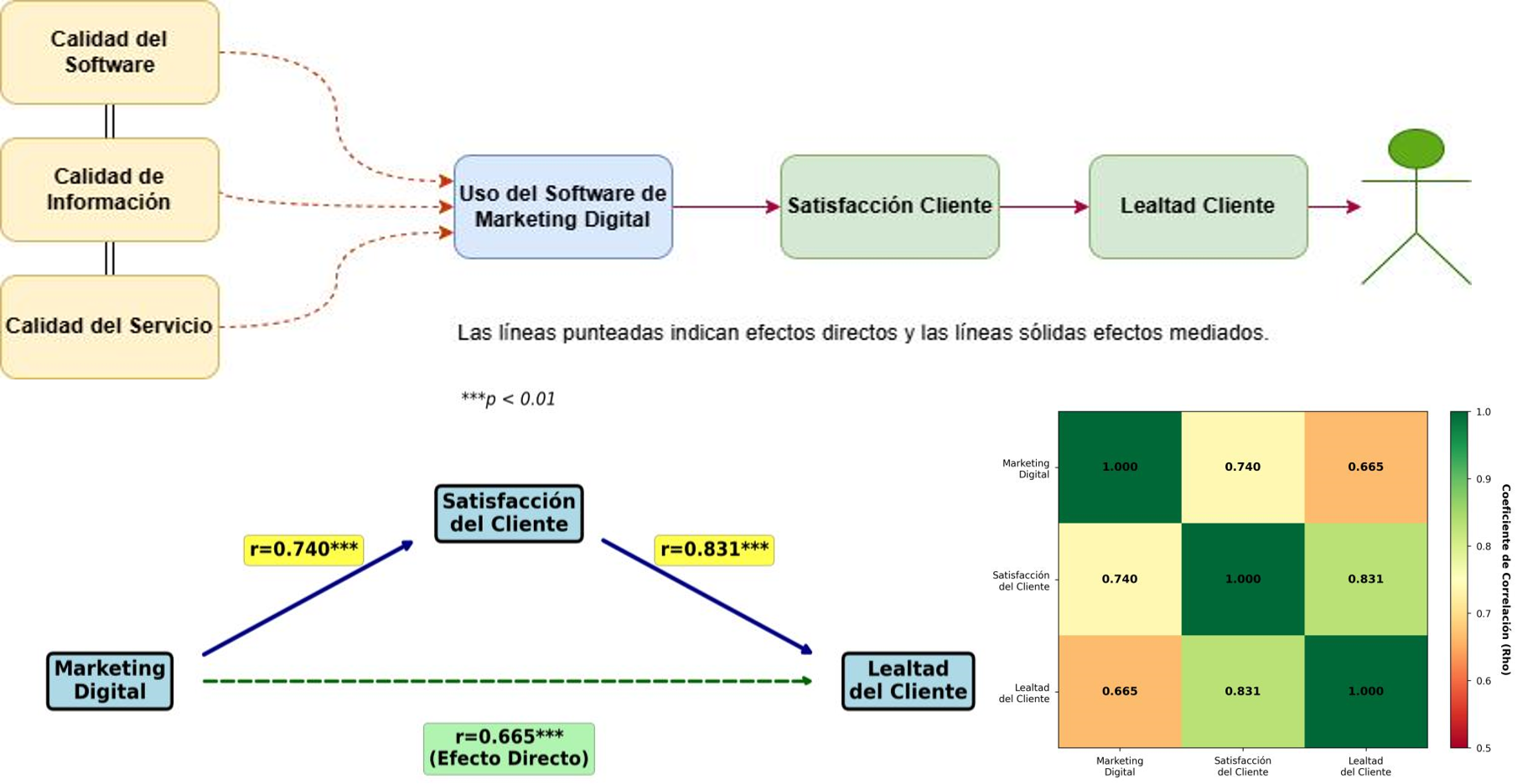
Este estudio analiza el rol mediador de la satisfacción del cliente en la relación entre los sistemas de marketing digital y la lealtad del cliente en el retail de moda de un mall de Tumbes, Perú, desde una perspectiva centrada en tecnologías de la información y sistemas digitales. Se adoptó un enfoque cuantitativo con diseño no experimental y alcance explicativo, utilizando una muestra de 384 consumidores de 12 establecimientos seleccionados mediante muestreo no probabilístico. Los datos se recolectaron mediante un cuestionario de 35 preguntas orientado a evaluar el desempeño de los sistemas de información de marketing digital, la satisfacción del cliente y la lealtad, y fueron analizados mediante estadística correlacional. Los resultados evidencian relaciones positivas y significativas entre los sistemas de marketing digital y la satisfacción del cliente, así como entre dichos sistemas y la lealtad, identificándose la asociación más fuerte entre satisfacción y lealtad. Estos hallazgos confirman una mediación parcial de la satisfacción, lo que expone que la infraestructura tecnológica, la calidad de la información y la interacción digital influyen en la lealtad tanto de manera directa como a través de la experiencia del cliente.
Citas
[1] H. Gil-Gomez, V. Guerola-Navarro, R. Oltra-Badenes, and J. A. Lozano-Quilis, “Customer relationship management: digital transformation and sustainable business model innovation,” Economic Research-Ekonomska Istraživanja, vol. 33, no. 1, pp. 2733–2750, Jan. 2020. https://doi.org/10.1080/1331677X.2019.1676283
[2] Y. Ali Hassan, S. R. M. Zeebaree, and Energy Eng. Dept., Technical College of Engineering, Duhok Polytechnic University, Duhok, Iraq, “Big Data Cloud Computing and AI-Driven Digital Marketing in Enterprise Systems,” ETJ, vol. 10, no. 04, Apr. 2025. https://doi.org/10.47191/etj/v10i04.28
[3] R. U. Khan, Y. Salamzadeh, Q. Iqbal, and S. Yang, “The Impact of Customer Relationship Management and Company Reputation on Customer Loyalty: The Mediating Role of Customer Satisfaction,” Journal of Relationship Marketing, vol. 21, no. 1, pp. 1–26, Jan. 2022. https://doi.org/10.1080/15332667.2020.1840904
[4] R. Jabado and R. Jallouli, “Enhancing Customer Relationship Management with Data Analytics: Insights from Retail Survey,” JTDE, vol. 12, no. 2, pp. 76–100, June 2024. https://doi.org/10.18080/jtde.v12n2.987
[5] B. A. Fida, U. Ahmed, Y. Al-Balushi, and D. Singh, “Impact of Service Quality on Customer Loyalty and Customer Satisfaction in Islamic Banks in the Sultanate of Oman,” Sage Open, vol. 10, no. 2, p. 2158244020919517, Apr. 2020. https://doi.org/10.1177/2158244020919517
[6] M. Gao and L. Huang, “Quality of channel integration and customer loyalty in omnichannel retailing: The mediating role of customer engagement and relationship program receptiveness,” Journal of Retailing and Consumer Services, vol. 63, p. 102688, Nov. 2021. https://doi.org/10.1016/j.jretconser.2021.102688
[7] H. GhorbanTanhaei, P. Boozary, S. Sheykhan, M. Rabiee, F. Rahmani, and I. Hosseini, “Predictive analytics in customer behavior: Anticipating trends and preferences,” Results in Control and Optimization, vol. 17, p. 100462, Dec. 2024. https://doi.org/10.1016/j.rico.2024.100462
[8] B. Oviedo-Bayas, E. López-Robayo, and C. G. Zambrano-Vega, “Artificial intelligence demand forecasting for improved inventory and fleet management,” JBES, vol. 1, no. 3, pp. 1–9, July 2025. https://doi.org/10.37956/jbes.v9i2.395
[9] P. Haessner, J. Haessner, and J. Thomas, “Maximizing Retail Potential: The Role of Big Data Analytics,” JSIS, vol. 19, no. 4, Jan. 2025. https://doi.org/10.33423/jsis.v19i4.7486
[10] X. Zhang, Y. Park, J. Park, and H. Zhang, “Demonstrating the influencing factors and outcomes of customer experience in omnichannel retail,” Journal of Retailing and Consumer Services, vol. 77, p. 103622, Mar. 2024. https://doi.org/10.1016/j.jretconser.2023.103622
[11] J. Tang, “Unlocking Retail Insights: Predictive Modeling and Customer Segmentation Through Data Analytics,” JTAER, vol. 20, no. 2, p. 59, Mar. 2025. https://doi.org/10.3390/jtaer20020059
[12] P. Thaichon, S. Quach, M. Barari, and M. Nguyen, “Exploring the Role of Omnichannel Retailing Technologies: Future Research Directions,” Australasian Marketing Journal, vol. 32, no. 2, pp. 162–177, May 2024. https://doi.org/10.1177/14413582231167664
[13] G. H. Sagala and D. Őri, “Toward SMEs digital transformation success: a systematic literature review,” Inf Syst E-Bus Manage, vol. 22, no. 4, pp. 667–719, Dec. 2024. https://doi.org/10.1007/s10257-024-00682-2
[14] M. M. H. Shahadat, Md. Nekmahmud, P. Ebrahimi, and M. Fekete-Farkas, “Digital Technology Adoption in SMEs: What Technological, Environmental and Organizational Factors Influence in Emerging Countries?,” Global Business Review, p. 09721509221137199, Jan. 2023. https://doi.org/10.1177/09721509221137199
[15] C. Ledro, A. Nosella, and I. Dalla Pozza, “Integration of AI in CRM: Challenges and guidelines,” Journal of Open Innovation: Technology, Market, and Complexity, vol. 9, no. 4, p. 100151, Dec. 2023. https://doi.org/10.1016/j.joitmc.2023.100151
[16] M. A. Ortiz-Chávez, J. E. Mendoza-Pumapillo, J. O. Dilas-Jiménez, and C. A. Mugruza-Vassallo, “E-commerce of Peruvian SMEs: Determinants of internet sales before and during COVID-19,” Heliyon, vol. 10, no. 23, p. e40331, Dec. 2024. https://doi.org/10.1016/j.heliyon.2024.e40331
[17] D. P. C. Galvez and S. Revinova, “Assessing Digital Technology Development in Latin American Countries: Challenges, Drivers, and Future Directions,” Digital, vol. 5, no. 2, p. 20, June 2025. https://doi.org/10.3390/digital5020020
[18] M. Cotarelo, T. Fayos, H. Calderón, and A. Mollá, “Omni-Channel Intensity and Shopping Value as Key Drivers of Customer Satisfaction and Loyalty,” Sustainability, vol. 13, no. 11, p. 5961, May 2021. https://doi.org/10.3390/su13115961
[19] P. B. Pires, B. M. Perestrelo, and J. D. Santos, “Unpacking Customer Experience in Online Shopping: Effects on Satisfaction and Loyalty,” JTAER, vol. 20, no. 3, p. 245, Sept. 2025. https://doi.org/10.3390/jtaer20030245
[20] J. D. Velásquez, “An analysis of trends, challenges, and opportunities in retail analytics,” International Journal of Market Research, vol. 67, no. 4, pp. 394–422, July 2025. https://doi.org/10.1177/14707853251315585
[21] H. W. Delone and R. E. McLean, “The DeLone and McLean Model of Information Systems Success: A Ten-Year Update,” Journal of Management Information Systems, vol. 19, no. 4, pp. 9–30, Apr. 2003. https://doi.org/10.1080/07421222.2003.11045748
[22] Y. Wang, “Assessing e‐commerce systems success: a respecification and validation of the DeLone and McLean model of IS success,” Information Systems Journal, vol. 18, no. 5, pp. 529–557, Sept. 2008. https://doi.org/10.1111/j.1365-2575.2007.00268.x
[23] S. Petter, W. DeLone, and E. R. McLean, “Information Systems Success: The Quest for the Independent Variables,” Journal of Management Information Systems, vol. 29, no. 4, pp. 7–62, Apr. 2013. https://doi.org/10.2753/MIS0742-1222290401
[24] F. D. Davis, “Perceived Usefulness, Perceived Ease of Use, and User Acceptance of Information Technology,” MIS Quarterly, vol. 13, no. 3, pp. 319–340, Sept. 1989. https://doi.org/10.2307/249008
[25] R. L. Oliver, “Whence Consumer Loyalty?,” Journal of Marketing, vol. 63, no. 4_suppl1, pp. 33–44, Oct. 1999. https://doi.org/10.1177/00222429990634s105
[26] J. F. Hair, C. M. Ringle, and M. Sarstedt, “PLS-SEM: Indeed a Silver Bullet,” Journal of Marketing Theory and Practice, vol. 19, no. 2, pp. 139–152, Apr. 2011. https://doi.org/10.2753/MTP1069-6679190202
[27] J. F. Hair, G. T. M. Hult, C. M. Ringle, M. Sarstedt, N. P. Danks, and S. Ray, Partial Least Squares Structural Equation Modeling (PLS-SEM) Using R: A Workbook. in Classroom Companion: Business. Cham: Springer International Publishing, 2021. https://doi.org/10.1007/978-3-030-80519-7
[28] D. Diansyah and P. Nadya, “The Effect of Digital Marketing and Product Quality on Customer Satisfaction with Purchase Decisions as a Moderation Variable at Cv. Carlitos Maju Pratama,” Return, vol. 2, no. 8, pp. 845–853, Aug. 2023. https://doi.org/10.57096/return.v2i8.136
[29] A. M. Anber Mohammad, “The Impact of Digital Marketing Success on Customer Loyalty,” MMI, vol. 13, no. 3, pp. 103–113, 2022. https://doi.org/10.21272/mmi.2022.3-09
[30] S. Mokhtar, M. Mus, and Mus, “An examination of the relationships between customer relationship management quality, service quality, customer satisfaction and customer loyalty: The case of five star hotels,” ASSRJ, vol. 6, no. 2, Feb. 2019. https://doi.org/10.14738/assrj.62.6202
[31] E. Kurniawan, N. Fitriani, M. I. Rahadian, A. W. Handaru, and S. I. Nikensari, “The Role of Digital Marketing, Customer Satisfaction, and Customer Trust in Maintaining Millennial Customer Loyalty: Case Study on the Tokopedia Indonesia Marketplace,” IJRCMS, vol. 05, no. 06, pp. 113–123, 2023. https://doi.org/10.38193/IJRCMS.2023.5609
[32] N. Suardhita, R. Martiwi, I. Elyana, and A. Rahman, “The Effect Of Customer Satisfaction And Trust On Customer Loyalty In The Shopee Marketplace,” Quant. Econ. Manag. Stud., vol. 5, no. 2, pp. 342–348, Apr. 2024. https://doi.org/10.35877/454RI.qems2494
[33] S.-U. Jung and V. Shegai, “The Impact of Digital Marketing Innovation on Firm Performance: Mediation by Marketing Capability and Moderation by Firm Size,” Sustainability, vol. 15, no. 7, p. 5711, Mar. 2023. https://doi.org/10.3390/su15075711
[34] S. Bachri, S. M. Putra, E. S. Farid, D. Darman, and A. G. Mayapada, “The Digital Marketing to Influence Customer Satisfaction Mediated by Purchase Decision,” JAM, vol. 21, no. 3, Sept. 2023. https://doi.org/10.21776/ub.jam.2023.021.03.03
[35] Javeed Sd, M. P., T. M., and D. M. P., “RT Based Railway Gates Automation Using NI myRIO,” IJSREM, vol. 08, no. 04, pp. 1–5, Apr. 2024. https://doi.org/10.55041/IJSREM31028
[36] T. Onibokun, A. Ejibenam, P. C. Ekeocha, K. D. Oladeji, and N. Halliday, “The impact of Personalization on Customer Satisfaction,” JFMR, vol. 4, no. 1, pp. 333–341, 2023. https://doi.org/10.54660/.JFMR.2023.4.1.333-341
[37] D. El-Shihy, M. Abdelraouf, and N. Hassan, “The path to fashion loyalty: insights from online fashion retailers and gender dynamics,” JFMM, May 2025. https://doi.org/10.1108/JFMM-10-2024-0428
[38] T. Hennig-Thurau, K. P. Gwinner, and D. D. Gremler, “Understanding Relationship Marketing Outcomes: An Integration of Relational Benefits and Relationship Quality,” Journal of Service Research, vol. 4, no. 3, pp. 230–247, Feb. 2002. https://doi.org/10.1177/1094670502004003006
[39] A. S. Ajina, J. M. M. Joudeh, N. N. Ali, A. M. Zamil, and T. N. Hashem, “The effect of mobile-wallet service dimensions on customer satisfaction and loyalty: An empirical study,” Cogent Business & Management, vol. 10, no. 2, p. 2229544, Dec. 2023. https://doi.org/10.1080/23311975.2023.2229544
[40] A. Stathopoulou and G. Balabanis, “The effects of loyalty programs on customer satisfaction, trust, and loyalty toward high- and low-end fashion retailers,” Journal of Business Research, vol. 69, no. 12, pp. 5801–5808, Dec. 2016. https://doi.org/10.1016/j.jbusres.2016.04.177
Publicado
Cómo citar
Número
Sección
Licencia
Derechos de autor 2026 Lexy Camila Escobar Medina, Serafín Osmar Peña Olaya, Ghenkis Ezcurra Zavaleta

Esta obra está bajo una licencia internacional Creative Commons Atribución-NoComercial-SinDerivadas 4.0.