Ciencias sociales y computación en el Perú: una radiografía de la producción científica universitaria
DOI:
https://doi.org/10.64439/cisai.v1i1.8Palabras clave:
Producción, Universidad, Perú, Sociales, ComputaciónResumen
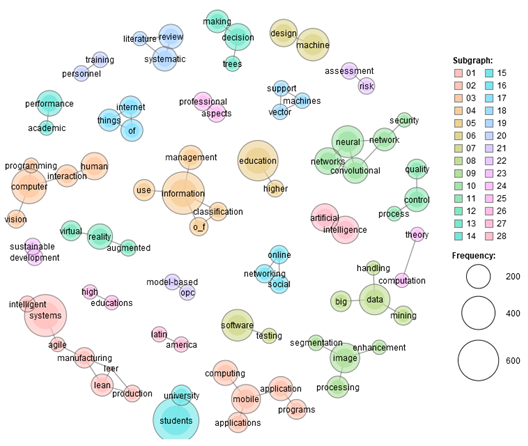
El estudio examinó la producción científica en ciencias sociales y computación de universidades peruanas entre 2013 y 2023, registrando un total de 16,443 investigaciones. Se identificaron áreas críticas que requieren atención, como la necesidad de ampliar la variedad de publicaciones, fomentando una mayor participación en congresos dentro de las ciencias sociales y promoviendo artículos de revisión en el campo de la computación. Entre los términos más frecuentes destacan “estudiantes”, “educación” y “humano”. En cuanto a productividad, la Universidad Peruana de Ciencias Aplicadas se posiciona a la cabeza en ciencias sociales, mientras que en computación lidera la Pontificia Universidad Católica del Perú. La preferencia por publicar en revistas extranjeras refleja el interés por una mayor visibilidad y calidad, aunque también evidencia la urgencia de fortalecer el financiamiento. Instituciones como la Pontificia Universidad Católica del Perú, Universidad Nacional de San Agustín de Arequipa, Universidad Privada del Norte, Universidad Nacional de Ingeniería y Universidad Nacional Mayor de San Marcos sobresalen por su apoyo económico. Se sugiere intensificar la internacionalización y explorar la capacidad financiera y científica de las universidades.
Citas
[1] O. S. Medina-Gómez, “Impacto de la pandemia de COVID-19 en las tendencias de mortalidad por enfermedades cardiovasculares en México, 2000-2022,” Medicina de Familia. SEMERGEN, vol. 50, no. 3, p. 102170, Apr. 2024. https://doi.org/10.1016/j.semerg.2023.102170
[2] H. G. Quezada-Pinedo et al., “A comprehensive analysis of cardiovascular mortality trends in Peru from 2017 to 2022: Insights from 183,386 deaths of the national death registry,” American Heart Journal Plus: Cardiology Research and Practice, vol. 35, p. 100335, Nov. 2023. https://doi.org/10.1016/j.ahjo.2023.100335
[3] J. A. Vázquez-Troche, V. García-Fernández, A. Hernández-Vásquez, R. Vargas-Fernández, and G. Bendezu-Quispe, “Trends in Mortality from Ischemic Heart Disease in Peru, 2005 to 2017,” IJERPH, vol. 19, no. 12, p. 7047, Jun. 2022. https://doi.org/10.3390/ijerph19127047
[4] M. A. Muzammil et al., “Artificial intelligence-enhanced electrocardiography for accurate diagnosis and management of cardiovascular diseases,” Journal of Electrocardiology, vol. 83, pp. 30–40, Mar. 2024. https://doi.org/10.1016/j.jelectrocard.2024.01.006
[5] Gian Luigi Nicolosi, “Perché l’intelligenza artificiale applicata all’elettrocardiogramma non è ancora routine clinica?,” Recenti Progressi in Medicina, no. 2023Marzo, Mar. 2023. https://doi.org/10.1701/3981.39635
[6] I. Rojek, P. Kotlarz, M. Kozielski, M. Jagodziński, and Z. Królikowski, “Development of AI-Based Prediction of Heart Attack Risk as an Element of Preventive Medicine,” Electronics, vol. 13, no. 2, p. 272, Jan. 2024. https://doi.org/10.3390/electronics13020272
[7] A. Irsyad, P. P. Widagdo, P. P. Widagdo, and R. Wardhana, “Deep learning Methods for ECG-Based Heart Disease Detection,” j.electron.electromedical.eng.med.inform, vol. 6, no. 4, pp. 467–477, Sep. 2024. https://doi.org/10.35882/jeeemi.v6i4.498
[8] M. Mandava and S. Reddy Vinta, “MDensNet201-IDRSRNet: Efficient cardiovascular disease prediction system using hybrid deep learning,” Biomedical Signal Processing and Control, vol. 93, p. 106147, Jul. 2024. https://doi.org/10.1016/j.bspc.2024.106147
[9] J. Moya-Salazar et al., “Geospatial analysis of cardiovascular mortality before and during the COVID-19 pandemic in Peru: analysis of the national death registry to support emergency management in Peru,” Front. Cardiovasc. Med., vol. 11, p. 1316192, Jun. 2024. https://doi.org/10.3389/fcvm.2024.1316192
[10] L. M. Davila-Zamora et al., “Artificial Intelligence Adoption in Emerging Economies: Challenges, Opportunities, And Strategies for Peru’s Business Transformation,” Pak.j.life.soc.sci., vol. 22, no. 2, 2024. https://doi.org/10.57239/PJLSS-2024-22.2.000864
[11] U. R. Acharya, H. Fujita, S. L. Oh, Y. Hagiwara, J. H. Tan, and M. Adam, “Application of deep convolutional neural network for automated detection of myocardial infarction using ECG signals,” Information Sciences, vol. 415–416, pp. 190–198, Nov. 2017. https://doi.org/10.1016/j.ins.2017.06.027
[12] S. Gustafsson et al., “Development and validation of deep learning ECG-based prediction of myocardial infarction in emergency department patients,” Sci Rep, vol. 12, no. 1, p. 19615, Nov. 2022. https://doi.org/10.1038/s41598-022-24254-x
[13] D. Doudesis et al., “Machine learning for diagnosis of myocardial infarction using cardiac troponin concentrations,” Nat Med, vol. 29, no. 5, pp. 1201–1210, May 2023. https://doi.org/10.1038/s41591-023-02325-4
[14] B. Toprak et al., “Diagnostic accuracy of a machine learning algorithm using point-of-care high-sensitivity cardiac troponin I for rapid rule-out of myocardial infarction: a retrospective study,” The Lancet Digital Health, vol. 6, no. 10, pp. e729–e738, Oct. 2024. https://doi.org/10.1016/S2589-7500(24)00191-2
[15] R. Khera et al., “Use of Machine Learning Models to Predict Death After Acute Myocardial Infarction,” JAMA Cardiol, vol. 6, no. 6, p. 633, Jun. 2021. https://doi.org/10.1001/jamacardio.2021.0122
[16] H. Yu, Y. Qi, and Y. Ding, “Deep Learning in RNA Structure Studies,” Front. Mol. Biosci., vol. 9, p. 869601, May 2022. https://doi.org/10.3389/fmolb.2022.869601
[17] Z. Hu, Y. Li, and Z. Yang, “Improving Convolutional Neural Network Using Pseudo Derivative ReLU,” in 2018 5th International Conference on Systems and Informatics (ICSAI), Nanjing: IEEE, Nov. 2018, pp. 283–287. https://doi.org/10.1109/ICSAI.2018.8599372
[18] I. Lauriola, “On the Impact of Early Stopping in Multiple Kernel Learning,” in Proceedings of the Future Technologies Conference (FTC) 2020, Volume 1, vol. 1288, K. Arai, S. Kapoor, and R. Bhatia, Eds., in Advances in Intelligent Systems and Computing, vol. 1288. , Cham: Springer International Publishing, 2021, pp. 205–215. https://doi.org/10.1007/978-3-030-63128-4_16
[19] D. J. Hand, P. Christen, and N. Kirielle, “F*: an interpretable transformation of the F-measure,” Mach Learn, vol. 110, no. 3, pp. 451–456, Mar. 2021. https://doi.org/10.1007/s10994-021-05964-1
[20] J. A. Martínez Pérez and P. S. Pérez Martin, “La curva ROC,” Medicina de Familia. SEMERGEN, vol. 49, no. 1, p. 101821, Jan. 2023. https://doi.org/10.1016/j.semerg.2022.101821
[21] J. T. Niedziela et al., “Is neural network better than logistic regression in death prediction in patients after ST-segment elevation myocardial infarction?,” Kardiol Pol, vol. 79, no. 12, pp. 1353–1361, Dec. 2021. https://doi.org/10.33963/KP.a2021.0142
[22] H. Silva Marchan, G. Ortiz Castro, O. J. M. Peña Cáceres, and M. A. More More, “Logistic regression: an example for the prediction of heart attacks,” in Proceedings of the 21th LACCEI International Multi-Conference for Engineering, Education and Technology (LACCEI 2023): “Leadership in Education and Innovation in Engineering in the Framework of Global Transformations: Integration and Alliances for Integral Development,” Latin American and Caribbean Consortium of Engineering Institutions, 2023. https://doi.org/10.18687/LACCEI2023.1.1.720
[23] M. Casciaro et al., “Predictors of Acute Myocardial Infarction: A Machine Learning Analysis After a 7-Year Follow-Up,” Clinics and Practice, vol. 15, no. 4, p. 72, Mar. 2025. https://doi.org/10.3390/clinpract15040072
[24] A. Choi et al., “Development of Prediction Models for Acute Myocardial Infarction at Prehospital Stage with Machine Learning Based on a Nationwide Database,” JCDD, vol. 9, no. 12, p. 430, Dec. 2022. https://doi.org/10.3390/jcdd9120430
Descargas
Publicado
Cómo citar
Número
Sección
Licencia
Derechos de autor 2025 Copyright (c) 2025 Andi Alvarado-Vargas, Karla Leon-Chuyes, Darwin Aguilar-Chuquizuta, Augusto Benavides-Medina

Esta obra está bajo una licencia internacional Creative Commons Atribución-NoComercial-SinDerivadas 4.0.