Information-technology-supported financial management model for SMEs in the food sector
DOI:
https://doi.org/10.64439/cisai.v2i2.19Keywords:
Financial management, information technologies, SMEs, food sector, financing, information systemsAbstract
Limited access to technological tools for financial management remains a challenge for Small and Medium-sized Enterprises
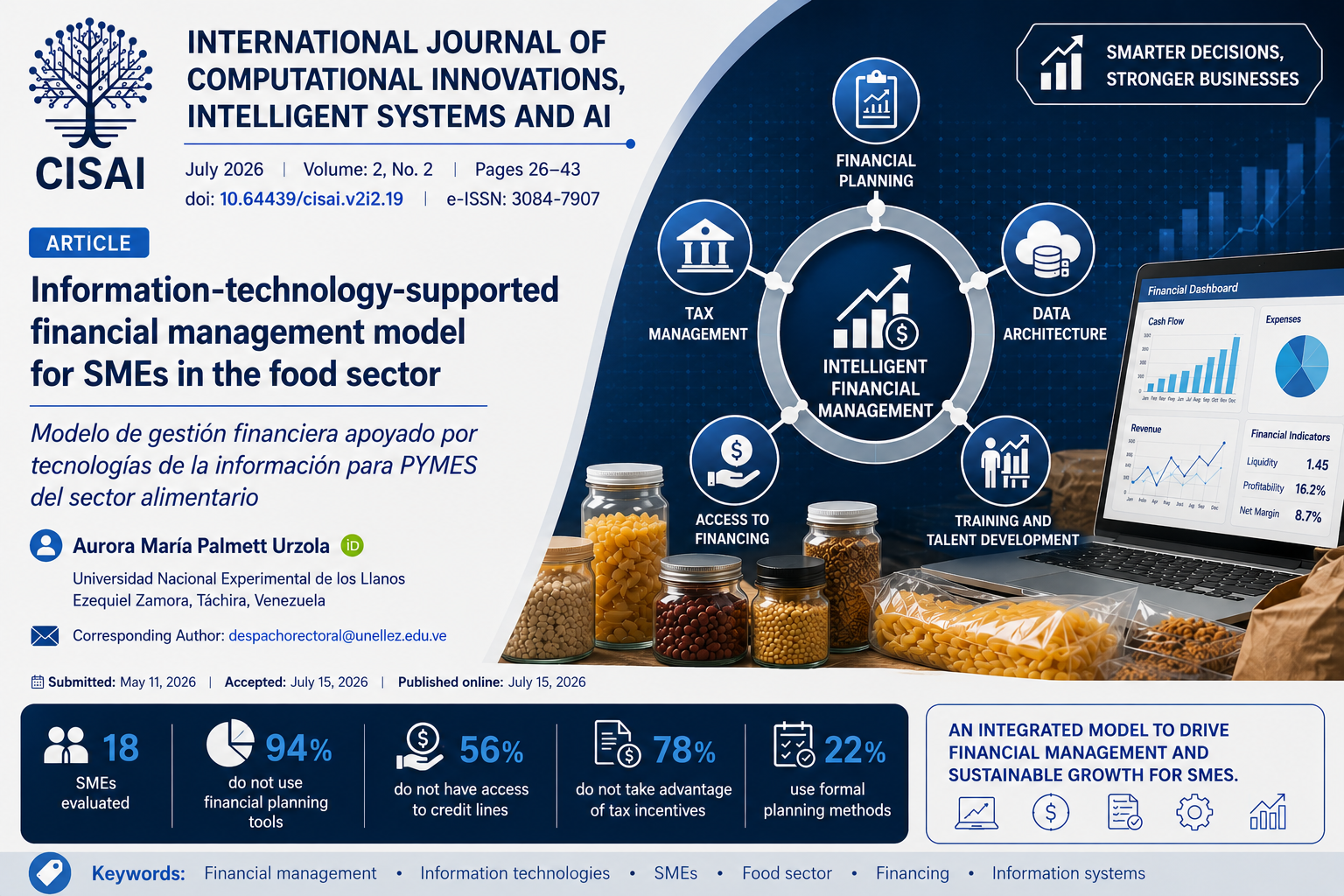
(SMEs), particularly in contexts where financial constraints limit their growth opportunities. Against this background, this study aimed to propose an information technology-supported financial management model for SMEs in the non-perishable food sector. A quantitative approach was used to assess the financial and technological gaps of 18 SMEs through a 35-item questionnaire, validated by experts, with reliability estimated using Cronbach’s alpha coefficient. The results showed that 94% of the SMEs do not use financial planning tools, 56% do not have access to credit lines, 78% do not take advantage of tax incentives, and only 22% use formal planning methods. Based on this assessment, a model was designed that integrates five technological components through a data architecture, a prioritization mechanism, and a twelve-month implementation roadmap. The findings suggest that the proposed model could translate the identified gaps into a gradual technology adoption strategy, providing a structured framework to guide the digitalization of SME financial management according to their specific needs and capabilities.
References
[1] M. Al-Okaily, A. F. Alkhwaldi, A. A. Abdulmuhsin, H. Alqudah, and A. Al-Okaily, “Cloud-based accounting information systems usage and its impact on Jordanian SMEs’ performance: The post-COVID-19 perspective,” Journal of Financial Reporting and Accounting, 2022. doi: 10.1108/JFRA-12-2021-0476.
[2] M. A. Al-sharafi, M. Iranmanesh, M. Al-emran, A. Ibrahim, F. Herzallah, and N. Jamil, “Determinants of cloud computing integration and its impact on sustainable performance in SMEs: An empirical investigation using the SEM-ANN approach,” Heliyon, vol. 9, no. 5, p. e16299, 2023. doi: 10.1016/j.heliyon.2023.e16299.
[3] K. Ragazou, I. Passas, A. Garefalakis, and C. Zopounidis, “Business intelligence model empowering SMEs to make better decisions and enhance their competitive advantage,” Discover Analytics, vol. 1, no. 1, p. 2, 2023. doi: 10.1007/s44257-022-00002-3.
[4] S. U. Rehman, M. Al-Shaikh, P. B. Washington, E. Lee, Z. Song, I. A. Abu-AlSondos, M. Shehadeh, and M. Allahham, “FinTech adoption in SMEs and bank credit supplies: A study on manufacturing SMEs,” Economies, vol. 11, no. 8, p. 213, 2023. doi: 10.3390/economies11080213.
[5] F. Kurniasari and E. D. Lestari, “Development of financial literacy and fintech adoption on women SMEs business performance in Indonesia,” Eastern-European Journal of Enterprise Technologies, vol. 5, no. 13 (131), pp. 67–75, 2024. doi: 10.15587/1729-4061.2024.312613.
[6] M. Bellon, E. Dabla-Norris, S. Khalid, and F. Lima, “Digitalization to improve tax compliance: Evidence from VAT e-invoicing in Peru,” Journal of Public Economics, vol. 210, p. 104661, 2022. doi: 10.1016/j.jpubeco.2022.104661.
[7] S. Hesami, H. Jenkins, and G. P. Jenkins, “Digital transformation of tax administration and compliance: A systematic literature review on e-invoicing and prefilled returns,” Digital Government: Research and Practice, vol. 5, no. 3, p. Article 18, 2024. doi: 10.1145/3643687.
[8] P. Nugraheni, E. S. Darma, and R. Muhammad, “Adoption of digital technology and financial knowledge: Strategies for achieving sustainable performance of MSMEs,” Journal of Risk and Financial Management, vol. 18, no. 11, p. 646, 2025. doi: 10.3390/jrfm18110646.
[9] F. Saruchera and S. Mpunzi, “Digital capital and food agricultural SMEs: Examining the effects on SME performance, inequalities and government role,” Cogent Business & Management, vol. 10, no. 1, p. 2191304, 2023. doi: 10.1080/23311975.2023.2191304.
[10] A. Jiménez-Rico, C. S. Gómez-López, and J. Zamilpa, “Determinants of access to bank financing in SMEs in Mexico,” Journal of Risk and Financial Management, vol. 16, no. 11, p. 477, 2023. doi: 10.3390/jrfm16110477.
[11] L. J. Cronbach, “Coefficient alpha and the internal structure of tests,” Psychometrika, vol. 16, no. 3, pp. 297–334, 1951. doi: 10.1007/BF02310555.
[12] C. Osorio-Gallego, J. Londoño-Metaute, and E. López-Zapata, “Analysis of factors that influence the ICT adoption by SMEs in Colombia,” Intangible Capital, vol. 12, no. 2, pp. 666–732, 2016. doi: 10.3926/ic.726.
[13] J. C. Raya, P. Cabe, and T. S. Pamulang, “Technology adoption in small-medium enterprises based on technology acceptance model: A critical review,” Journal of Information Systems Engineering and Business Intelligence, vol. 7, no. 2, pp. 162–172, 2021. doi: 10.20473/jisebi.7.2.162-172.
[14] R. Babalghaith and A. Aljarallah, “Factors affecting big data analytics adoption in small and medium enterprises,” Information Systems Frontiers, vol. 26, no. 6, pp. 2165–2187, 2024. doi: 10.1007/s10796-024-10538-2.
[15] I. Bawono, E. Maulina, M. Rizal, and M. Purnomo, “The role of knowledge management capability, financial literacy, and problem-solving skills on organizational performance for SMEs,” Frontiers in Psychology, vol. 13, p. 930742, 2022. doi: 10.3389/fpsyg.2022.930742.
[16] P. Kumar, R. Pillai, N. Kumar, and M. I. Tabash, “The interplay of skills, digital financial literacy, capability, and autonomy in financial decision making and well-being,” Borsa Istanbul Review, vol. 23, no. 1, pp. 169–183, 2023. doi: 10.1016/j.bir.2022.09.012.
[17] G. A. Afrifa and I. Tingbani, “Working capital management, cash flow and SMEs’ performance,” International Journal of Banking, Accounting and Finance, vol. 9, no. 1, pp. 19–43, 2018. doi: 10.1504/IJBAAF.2018.10010466.
Downloads
Published
How to Cite
Issue
Section
License
Copyright (c) 2026 International Journal of Computational Innovations, Intelligent Systems and AI

This work is licensed under a Creative Commons Attribution-NonCommercial-NoDerivatives 4.0 International License.