Modelo de gestión financiera apoyado por tecnologías de la información para PYMES del sector alimentario
DOI:
https://doi.org/10.64439/cisai.v2i2.19Palabras clave:
Gestión financiera, tecnologías de la información, PYMES, sector alimentario, financiamiento, sistemas de informaciónResumen
El acceso limitado a herramientas tecnológicas para la gestión financiera continúa siendo una dificultad para las Pequeñas
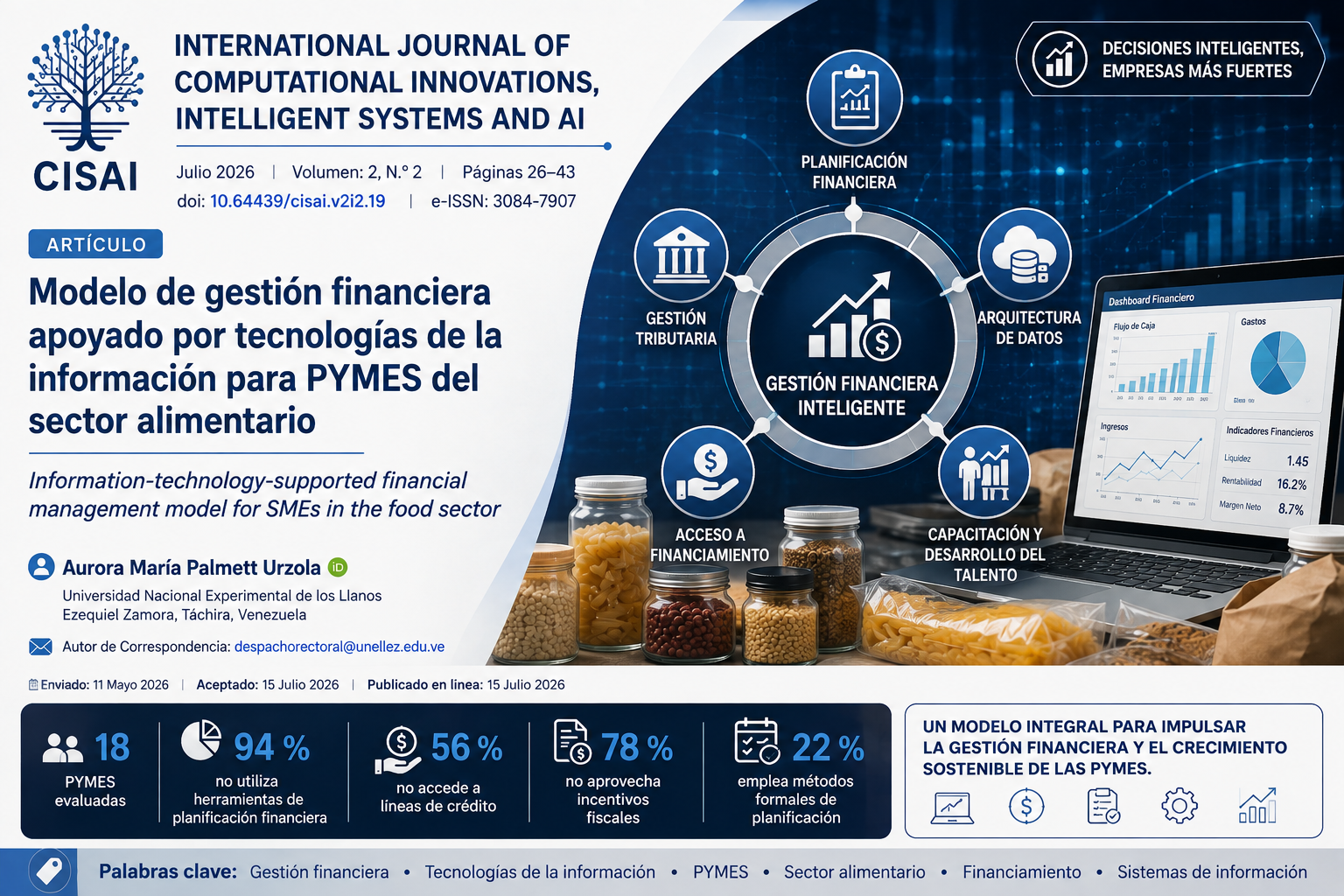
y Medianas Empresas (PYMES), especialmente en contextos donde las restricciones financieras reducen sus posibilidades de crecimiento. En este escenario, el objetivo del estudio fue proponer un modelo de gestión financiera apoyado en tecnologías de la información para PYMES del sector de alimentos no perecederos. Se empleó un enfoque cuantitativo para diagnosticar las brechas financieras y tecnológicas de 18 PYMES mediante un cuestionario de 35 ítems, validado por expertos y con confiabilidad estimada mediante el coeficiente Alfa de Cronbach. Los resultados mostraron que el 94% no utiliza herramientas de planificación financiera, el 56% no accede a líneas de crédito, el 78% no aprovecha incentivos fiscales y solo el 22% emplea métodos formales de planificación. A partir del diagnóstico, se diseñó un modelo que integra cinco componentes tecnológicos mediante una arquitectura de datos, un mecanismo de priorización y una hoja de ruta de doce meses. Se concluye que la propuesta podría transformar las brechas identificadas en una estrategia gradual de adopción tecnológica, proporcionando un marco estructurado para orientar la digitalización de la gestión financiera de las PYMES según sus necesidades y capacidades.
Citas
[1] M. Al-Okaily, A. F. Alkhwaldi, A. A. Abdulmuhsin, H. Alqudah, and A. Al-Okaily, “Cloud-based accounting information systems usage and its impact on Jordanian SMEs’ performance: The post-COVID-19 perspective,” Journal of Financial Reporting and Accounting, 2022. doi: 10.1108/JFRA-12-2021-0476.
[2] M. A. Al-sharafi, M. Iranmanesh, M. Al-emran, A. Ibrahim, F. Herzallah, and N. Jamil, “Determinants of cloud computing integration and its impact on sustainable performance in SMEs: An empirical investigation using the SEM-ANN approach,” Heliyon, vol. 9, no. 5, p. e16299, 2023. doi: 10.1016/j.heliyon.2023.e16299.
[3] K. Ragazou, I. Passas, A. Garefalakis, and C. Zopounidis, “Business intelligence model empowering SMEs to make better decisions and enhance their competitive advantage,” Discover Analytics, vol. 1, no. 1, p. 2, 2023. doi: 10.1007/s44257-022-00002-3.
[4] S. U. Rehman, M. Al-Shaikh, P. B. Washington, E. Lee, Z. Song, I. A. Abu-AlSondos, M. Shehadeh, and M. Allahham, “FinTech adoption in SMEs and bank credit supplies: A study on manufacturing SMEs,” Economies, vol. 11, no. 8, p. 213, 2023. doi: 10.3390/economies11080213.
[5] F. Kurniasari and E. D. Lestari, “Development of financial literacy and fintech adoption on women SMEs business performance in Indonesia,” Eastern-European Journal of Enterprise Technologies, vol. 5, no. 13 (131), pp. 67–75, 2024. doi: 10.15587/1729-4061.2024.312613.
[6] M. Bellon, E. Dabla-Norris, S. Khalid, and F. Lima, “Digitalization to improve tax compliance: Evidence from VAT e-invoicing in Peru,” Journal of Public Economics, vol. 210, p. 104661, 2022. doi: 10.1016/j.jpubeco.2022.104661.
[7] S. Hesami, H. Jenkins, and G. P. Jenkins, “Digital transformation of tax administration and compliance: A systematic literature review on e-invoicing and prefilled returns,” Digital Government: Research and Practice, vol. 5, no. 3, p. Article 18, 2024. doi: 10.1145/3643687.
[8] P. Nugraheni, E. S. Darma, and R. Muhammad, “Adoption of digital technology and financial knowledge: Strategies for achieving sustainable performance of MSMEs,” Journal of Risk and Financial Management, vol. 18, no. 11, p. 646, 2025. doi: 10.3390/jrfm18110646.
[9] F. Saruchera and S. Mpunzi, “Digital capital and food agricultural SMEs: Examining the effects on SME performance, inequalities and government role,” Cogent Business & Management, vol. 10, no. 1, p. 2191304, 2023. doi: 10.1080/23311975.2023.2191304.
[10] A. Jiménez-Rico, C. S. Gómez-López, and J. Zamilpa, “Determinants of access to bank financing in SMEs in Mexico,” Journal of Risk and Financial Management, vol. 16, no. 11, p. 477, 2023. doi: 10.3390/jrfm16110477.
[11] L. J. Cronbach, “Coefficient alpha and the internal structure of tests,” Psychometrika, vol. 16, no. 3, pp. 297–334, 1951. doi: 10.1007/BF02310555.
[12] C. Osorio-Gallego, J. Londoño-Metaute, and E. López-Zapata, “Analysis of factors that influence the ICT adoption by SMEs in Colombia,” Intangible Capital, vol. 12, no. 2, pp. 666–732, 2016. doi: 10.3926/ic.726.
[13] J. C. Raya, P. Cabe, and T. S. Pamulang, “Technology adoption in small-medium enterprises based on technology acceptance model: A critical review,” Journal of Information Systems Engineering and Business Intelligence, vol. 7, no. 2, pp. 162–172, 2021. doi: 10.20473/jisebi.7.2.162-172.
[14] R. Babalghaith and A. Aljarallah, “Factors affecting big data analytics adoption in small and medium enterprises,” Information Systems Frontiers, vol. 26, no. 6, pp. 2165–2187, 2024. doi: 10.1007/s10796-024-10538-2.
[15] I. Bawono, E. Maulina, M. Rizal, and M. Purnomo, “The role of knowledge management capability, financial literacy, and problem-solving skills on organizational performance for SMEs,” Frontiers in Psychology, vol. 13, p. 930742, 2022. doi: 10.3389/fpsyg.2022.930742.
[16] P. Kumar, R. Pillai, N. Kumar, and M. I. Tabash, “The interplay of skills, digital financial literacy, capability, and autonomy in financial decision making and well-being,” Borsa Istanbul Review, vol. 23, no. 1, pp. 169–183, 2023. doi: 10.1016/j.bir.2022.09.012.
[17] G. A. Afrifa and I. Tingbani, “Working capital management, cash flow and SMEs’ performance,” International Journal of Banking, Accounting and Finance, vol. 9, no. 1, pp. 19–43, 2018. doi: 10.1504/IJBAAF.2018.10010466.
Descargas
Publicado
Cómo citar
Número
Sección
Licencia
Derechos de autor 2026 International Journal of Computational Innovations, Intelligent Systems and AI

Esta obra está bajo una licencia internacional Creative Commons Atribución-NoComercial-SinDerivadas 4.0.